
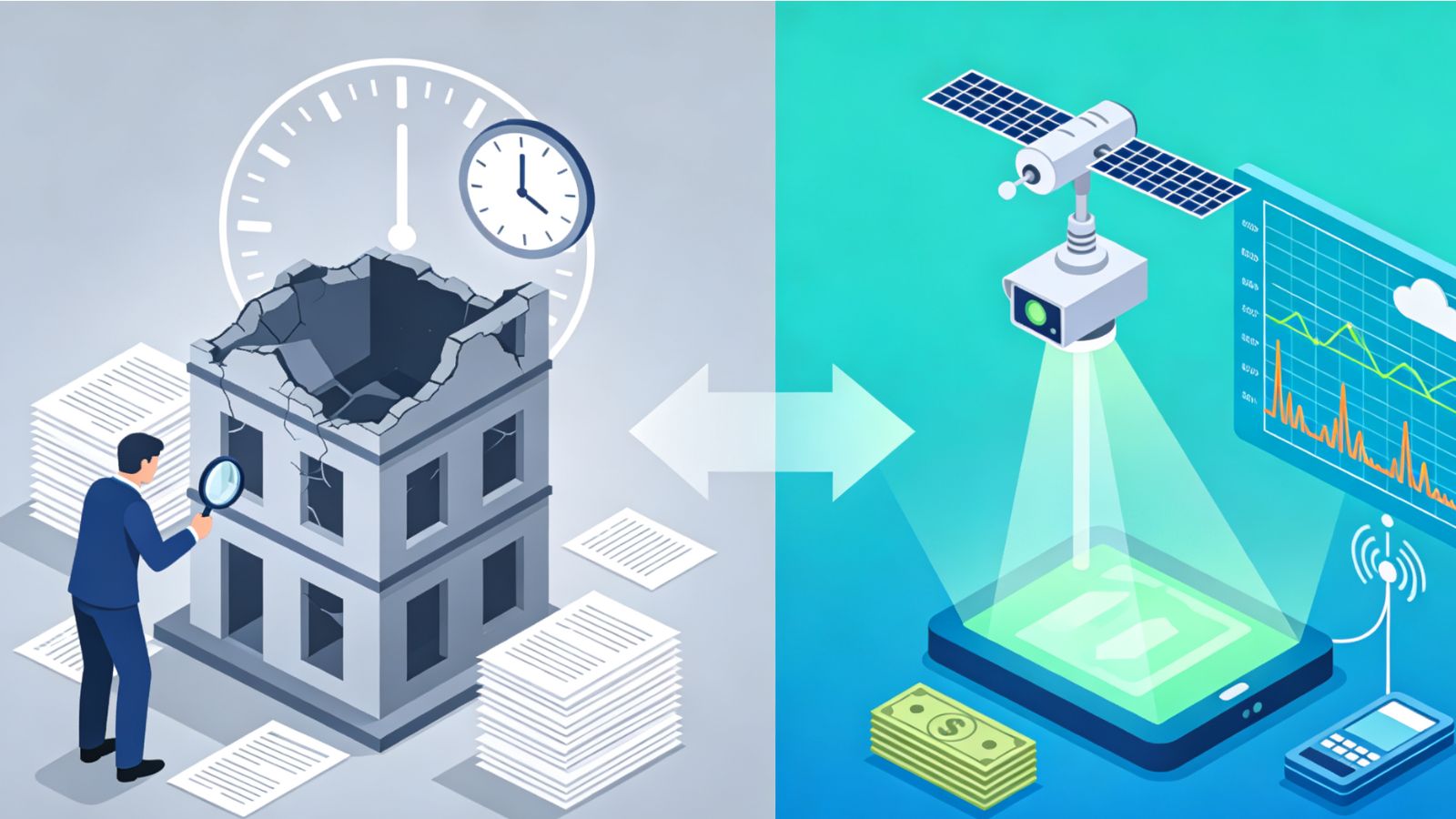
When a major disaster occurs, traditional insurance usually depends on a detailed assessment of financial losses before compensation can be determined. Insurers inspect damage, review documentation, and calculate payments according to the terms of the policy. This approach helps ensure that payments reflect actual losses, but it can also take time, especially after large-scale events affecting many policyholders at once.
Parametric insurance models use a different method. Instead of measuring the exact amount of damage after an event, these policies rely on predefined triggers based on measurable conditions. When a specific threshold is reached, the policy provides a predetermined payment according to the contract terms.
The difference is not simply about faster claims. Parametric insurance represents a different way of transferring risk. Traditional indemnity insurance focuses on compensating verified losses, while parametric insurance focuses on providing financial support when a defined event occurs. Rather than replacing traditional coverage, parametric models are becoming an additional risk management tool for situations where conventional claims processes may be slow, complex, or difficult to apply.
Insurance markets have traditionally relied on damage assessment because most policies are designed to match compensation with the financial impact of a loss. However, some risks create challenges that do not fit easily into this model.
Large-scale disasters are one example. Hurricanes, earthquakes, droughts, and severe storms can affect thousands of policyholders at the same time. After a major event, insurers may face difficulties inspecting damage quickly while businesses, governments, and communities need immediate financial resources for recovery.
Parametric insurance addresses part of this challenge by linking payments to measurable events rather than individual loss calculations. If a predefined condition is reached, payment can be triggered without waiting for a traditional claims assessment.
The World Bank has supported catastrophe risk financing initiatives that use insurance-based mechanisms and predefined triggers to help governments access funds after disasters. These programs demonstrate how parametric structures can be used as part of broader disaster preparedness strategies. However, parametric insurance is not intended to replace traditional insurance; in many situations, it works alongside conventional policies by providing additional protection for specific risks.
A parametric insurance contract depends on carefully designed triggers. These triggers must be measurable, independently verifiable, and clearly defined before the policy begins.
Unlike traditional insurance, where the central question is usually “How much damage occurred?”, parametric insurance asks a different question: “Did the agreed event occur according to the predefined measurement?” The answer comes from objective data sources such as weather monitoring systems, seismic instruments, satellite information, or catastrophe models.
Weather-related triggers are among the most common applications of parametric insurance. Policies may use measurements such as:
Rainfall levels during a specific period
Wind speed during a storm
Temperature thresholds
Snowfall or water availability measurements
Agriculture is one area where weather-based insurance models have gained attention. Farmers can experience significant financial losses from drought, excessive rainfall, or other weather conditions. Traditional assessments may require time-consuming evaluations of crop damage, while a weather-based trigger can provide quicker financial support when conditions meet the agreed threshold.
Earthquake-related parametric policies may rely on measurements such as earthquake magnitude or ground acceleration.
Because earthquake damage can vary significantly depending on location and building conditions, determining total losses immediately after an event can be difficult. A seismic trigger allows payments to be calculated using objective measurements rather than waiting for every individual loss to be assessed.
Some parametric products use catastrophe models that combine scientific data, geographic information, and historical risk analysis.
These models are designed to estimate whether an event reaches a level of severity that activates coverage. The quality of the model and the underlying data are critical because they directly affect whether the trigger reflects the risk being insured.
Parametric insurance has attracted interest in the United States, particularly in areas where rapid financial response is valuable or where traditional loss assessment can be challenging.
Agriculture is one example. U.S. agricultural risks are strongly influenced by weather conditions, and insurance structures that use measurable factors can help address certain types of exposure. These approaches may be useful when the timing of financial support is as important as the final calculation of losses.
Businesses can also use parametric insurance as part of broader risk management planning. Companies with exposure to weather disruptions, tourism interruptions, or supply chain challenges may consider these products as a way to access funds after specific events.
For example, a coastal hotel could use hurricane-triggered coverage designed to provide emergency liquidity if wind speeds at a specified monitoring location exceed a predetermined threshold. The payment would not necessarily equal the hotel’s total financial loss, but it could provide resources for immediate recovery expenses while traditional insurance claims are still being evaluated.
Parametric insurance is generally most relevant for organizations that need rapid access to funds after clearly defined events, especially when conventional claims assessment may take longer or when certain risks are difficult to measure through traditional methods.
One of the most recognized benefits of parametric insurance is speed. Because payments depend on predefined triggers rather than detailed damage assessments, funds may become available sooner after a qualifying event.
This can be particularly valuable after disasters, when organizations need money for emergency operations, temporary repairs, or recovery efforts.
Traditional claims often involve uncertainty because final payments depend on inspections, documentation, and policy interpretation.
Parametric contracts provide clearer expectations because the trigger conditions and payment amounts are established in advance. Policyholders know what event activates coverage and what payment structure applies.
Some risks are difficult to manage through traditional insurance because losses are expensive to evaluate or occur across large geographic areas.
Parametric models can help address certain protection gaps by focusing on measurable events rather than requiring every individual loss to be calculated.
The most important limitation of parametric insurance is basis risk, which occurs when the trigger does not perfectly match the policyholder’s actual financial loss. A business may experience serious storm damage, but if the measured wind speed does not reach the required threshold, the policy may not make a payment.
The opposite can also occur. A trigger may be reached even when the policyholder experiences limited direct damage. In that situation, the payment may exceed the actual loss.
These outcomes reflect the structure of parametric insurance rather than necessarily indicating a problem with the product. The policy is designed around the occurrence of a measurable event, not a complete reimbursement of every individual expense.
Because of this, contract design is essential. The choice of data source, measurement location, trigger threshold, and payment amount determines whether a parametric policy provides meaningful protection.
Parametric insurance is best understood as a complement to traditional indemnity-based coverage rather than a replacement. Traditional insurance remains essential because it connects compensation directly to verified losses, such as property damage, equipment failures, or liability claims. Parametric insurance serves a different purpose by providing predefined payments when specific measurable events occur.
For many organizations, the two approaches can work together. A business may use conventional property insurance to address physical damage after a disaster while adding parametric coverage to provide faster access to funds for immediate expenses. For example, a company affected by a severe storm may need resources for temporary operations, emergency repairs, or supply chain adjustments before a traditional claim has been fully evaluated.
This combination reflects a broader shift in risk management. Instead of relying on a single insurance product, organizations are increasingly examining multiple financial tools designed for different types of uncertainty. Traditional policies remain important for losses that require detailed evaluation, while parametric solutions may provide additional support for events that can be measured through reliable data.
The development of satellite monitoring, weather technology, and analytical models is expanding the potential uses of parametric insurance. Better data allows insurers and risk managers to design more specific triggers and create products for risks that were previously difficult to measure.
However, technology alone does not determine whether a parametric product is effective. The quality of the trigger, the reliability of the data source, and the relationship between the measured event and the actual financial impact remain critical factors. A well-designed parametric policy requires clear terms so that policyholders understand what conditions will activate payment and what risks remain outside the coverage.
As climate-related risks, business disruptions, and large-scale events continue to challenge traditional risk management methods, parametric insurance may become a more common part of broader protection strategies. Its role will likely depend not on replacing conventional insurance, but on providing another option for managing specific risks where speed and predictability are valuable.

Parametric insurance models represent a shift from measuring losses after an event to preparing for specific measurable risks before they occur.
By using predefined triggers, these policies can provide faster payments, greater predictability, and additional protection for risks that may be difficult to address through traditional insurance alone. However, they also require careful design because a trigger may not always perfectly match the financial impact experienced by a policyholder.
As data technology and risk management strategies continue to develop, parametric insurance is likely to remain an important complement to traditional insurance systems. Its value depends on using the right triggers for the right risks and ensuring that policyholders understand exactly how protection is structured.