
When people compare insurance policies or employee benefit plans, they often begin with the details that are easiest to identify: the cost, the amount of coverage, and the types of losses or services included. However, the practical value of a policy often depends on another set of details that receive less attention: the timing clauses.
These provisions determine when coverage becomes available, when benefits can begin after a qualifying event, and how long financial support may continue. For employees and policyholders, these details often become most important when income has already been interrupted and access to benefits is urgently needed. A policy that appears attractive on paper may provide very different protection depending on whether payments begin after 30 days, 90 days, or several months.
Three timing concepts appear frequently in insurance and benefit arrangements: waiting periods, elimination periods, and benefit periods. Although these terms are closely related, each one affects a different stage of the coverage timeline.
Insurance policies usually follow a sequence of events. A person may first become eligible for coverage, later experience a qualifying event, complete a required waiting period, and then receive benefits for a specific length of time. Because of this sequence, the amount of coverage alone does not tell the complete story.
For example, a long-term disability insurance policy may replace a percentage of an employee’s income, but the financial impact depends heavily on when those payments actually begin. Someone with limited savings may experience a significant difference between a policy that starts paying after 60 days and one that requires a 180-day elimination period before benefits become available.
Timing clauses create predictable expectations for both insurers and policyholders. They help insurers manage risk while allowing individuals to understand when financial assistance may become available and how long that support could last.

A waiting period is a set amount of time that must pass before an individual becomes eligible for coverage or a specific benefit.
Waiting periods are common in employer-sponsored benefit programs. For example, a newly hired employee may need to complete a waiting period before enrolling in an employer health insurance plan. This creates a consistent process for determining when employees can access coverage.
Under the Affordable Care Act (ACA), certain employer-sponsored group health plans generally cannot require eligible employees to wait more than 90 days before health coverage begins. The exact requirements depend on factors such as the type of plan, employee eligibility status, and applicable regulations.
A waiting period does not mean coverage has been refused. Instead, it defines when access to a benefit begins. This distinction matters because a person may be eligible for a plan but still need to complete the required waiting period before receiving coverage.
A waiting period is also different from an elimination period. A waiting period usually occurs before a person can access a plan or benefit, while an elimination period generally applies after a covered event has already happened.
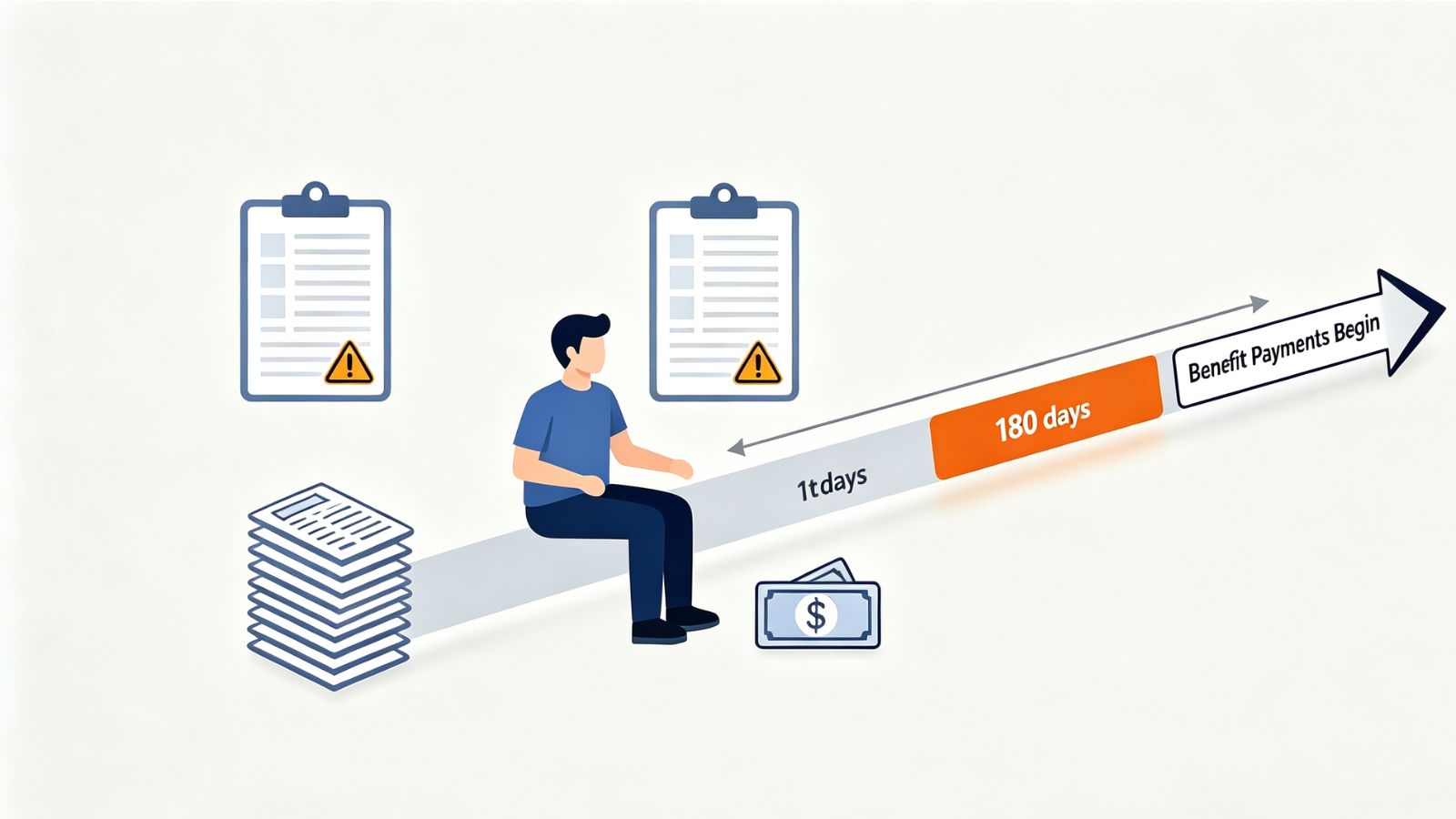
An elimination period is the amount of time an insured person must wait after a qualifying event before benefit payments begin.
This concept is commonly used in disability insurance and long-term care insurance. The clock typically starts after the insured person meets the policy requirements for a covered condition.
Consider an employee with a long-term disability insurance policy that includes a 180-day elimination period. If the employee becomes disabled on January 1 and satisfies the policy’s definition of disability, long-term disability payments may not begin until the elimination period has ended.
During that period, the employee may need to rely on other resources to maintain financial stability until benefits become available. Depending on the situation, those resources may include:
Emergency savings
Paid leave from an employer
Short-term disability benefits
Other available income sources
The length of an elimination period can affect both premiums and financial planning. A shorter elimination period may provide faster access to benefits but may come with higher costs. A longer elimination period may reduce premiums but requires the policyholder to manage a longer period without payments.
The most suitable option depends on factors such as financial circumstances, existing workplace benefits, and the level of protection an individual needs.
A benefit period describes how long benefits may continue after eligibility requirements have been met and payments have started.
In disability insurance, benefit periods can vary significantly. Some policies provide benefits for a limited number of years, while others may continue until a specified age if the insured person continues to meet the policy conditions.
Different types of coverage use benefit periods in different ways. Short-term disability plans often provide income replacement for a limited period, such as several weeks or months. Long-term disability policies may provide benefits for several years or potentially until a specific age, depending on the contract. Long-term care insurance may provide benefits for a defined period of covered care.
The benefit period is important because it determines how long financial support may last. However, a longer benefit period does not automatically make one policy better. Other factors, including coverage definitions, exclusions, claim requirements, and premium costs, also affect the overall value of coverage.
Waiting periods, elimination periods, and benefit periods describe different stages in the same overall timeline.
A waiting period determines when a person becomes eligible for coverage or a benefit. An elimination perioddetermines how long a person must wait after a qualifying event before payments begin. A benefit period determines how long payments or services may continue once benefits become payable.
A typical timeline may look like this:
Employment begins → Waiting period completed → Coverage becomes available → Covered event occurs → Elimination period completed → Benefit payments begin → Benefit period ends
Not every insurance product uses all three stages. Some plans may only include eligibility requirements, while others include several timing provisions that affect claims, payments, and coverage duration.
Joining a plan does not always mean every benefit becomes available immediately. Some coverage begins only after a required waiting period has been completed.
A deductible usually refers to a financial amount that must be paid before certain coverage applies. An elimination period is based on time rather than money and determines when benefits begin after a qualifying event.
The size of a monthly benefit is important, but timing can be equally significant. A benefit that starts too late or ends too quickly may not provide the level of protection a person expects during a financial hardship.
Timing provisions often depend on other parts of the contract. For example, disability insurance payments may depend on how the policy defines disability, not simply whether someone is unable to perform their job.
Before selecting an insurance policy or evaluating workplace benefits, readers should look beyond the headline coverage amount and review the full timeline created by the contract.
Several questions can help clarify how a policy works:
Check whether there is an eligibility waiting period and whether different benefits have different start dates.
Review the policy’s definition of a qualifying event. In disability insurance, this may involve meeting specific requirements stated in the contract.
Look at the maximum benefit period and identify conditions that could end payments earlier than expected.
Timing clauses may interact with other provisions involving:
Pre-existing conditions
Claim filing deadlines
Required documentation
Renewal terms
Changes in eligibility
The policy document and official plan materials usually provide more complete information than a summary description.
Imagine an employee has long-term disability insurance with a 180-day elimination period.
On January 1, the employee becomes disabled and meets the policy’s claim requirements. From January 1 through June 29, the elimination period applies, meaning the employee may need to rely on savings, employer benefits, or other resources during this time.
On June 30, long-term disability payments begin. After payments start, the benefit period determines how long the employee may continue receiving benefits, assuming all policy requirements remain satisfied.
This example shows why timing clauses are not just technical contract language. They determine when protection becomes available and how long that protection can continue.
No. A waiting period generally determines when someone becomes eligible for coverage, while an elimination period usually applies after a covered event and delays benefit payments.
Yes. Differences in elimination periods, benefit periods, exclusions, and eligibility rules can significantly change how useful a policy may be in practice.
It depends on the insurance contract and the provider’s rules. Some policies may allow adjustments during certain enrollment periods or through a new application process, while others may not allow changes after coverage begins.
For general information, consumers can review resources from organizations such as state insurance departments, the National Association of Insurance Commissioners (NAIC), the U.S. Department of Labor for employee benefit information, and the Centers for Medicare & Medicaid Services for applicable health coverage rules.
Timing clauses determine how insurance and benefit plans operate in practice. Waiting periods establish when eligibility begins, elimination periods determine when payments can start after a qualifying event, and benefit periods define how long support may continue.
For employees, policyholders, and organizations, these provisions influence financial planning and expectations during situations when reliable support matters most. A careful review of timing clauses can help people better understand their coverage, compare options more effectively, and avoid unexpected gaps between experiencing a covered event and receiving benefits.
This article provides general information about insurance timing clauses and is not a substitute for reviewing individual policy documents or seeking professional insurance advice when making coverage decisions.